Today, more than ever, the important role that nutrition plays in human health is evident. In fact, although the individual's genetic pattern is unchangeable, the environment in which we live and the food we eat can influence our gene set, making people more prone to developing certain diseases. In particular, studies in humans and animals have shown that nutrients can activate the expression of genes that protect against diseases and inhibit that of genes that promote them. This mechanism can therefore be exploited to promote a state of health in individuals with physiological alterations: this is possible thanks to the application of nutrigenomics in the field of supplements.
The dynamic interaction between genes and nutrients is studied by nutrigenomics, one of the most fascinating frontiers in food and nutrition. It can be defined as the discipline that observes the impact on the human genome of various elements (macronutrients, micronutrients and bioactive compounds) introduced through diet.
Nutrigenomics, therefore, studies how nutrition influences the switching on or off of the message contained in genes. In this context, nutrients are seen as signals that tell the body how to behave. In this way, DNA is directed towards promoting a state of health and well-being.
This mechanism can be positively exploited by nutraceutics. Indeed, similar to food and the support of a balanced diet, the active ingredients of food supplements also have the power to influence gene expression involved in metabolism, thus reducing the risk of developing related diseases.
Given a physiological alteration, it is therefore possible to intervene by identifying active ingredients capable of exerting effects on the genes involved in that specific alteration, thus formulating food supplements whose mechanism of action is known in depth with proven efficacy.
Nutrigenomics applied to supplements therefore aims to overcome the limitations of more traditional approaches by adopting a method that considers not only the genetic aspects of diseases, but also the dynamic interaction between genes and the environment. This new paradigm makes it possible to develop innovative, science-driven food supplements aimed at maximising efficacy in improving people's well-being.
By studying the interactions between nutrients and the human genome and exploiting the potential of nutraceutics and nutrigenomics, it is therefore possible to identify compounds that can positively influence gene expression and promote the restoration of a healthy condition.
Based on this assumption, Biofarma Group, a leading CDMO with a strong vocation for innovation, proposes an approach to nutraceutics that exploits the potential of nutrigenomics and takes the form of two different types of service: product testing and product co-development.
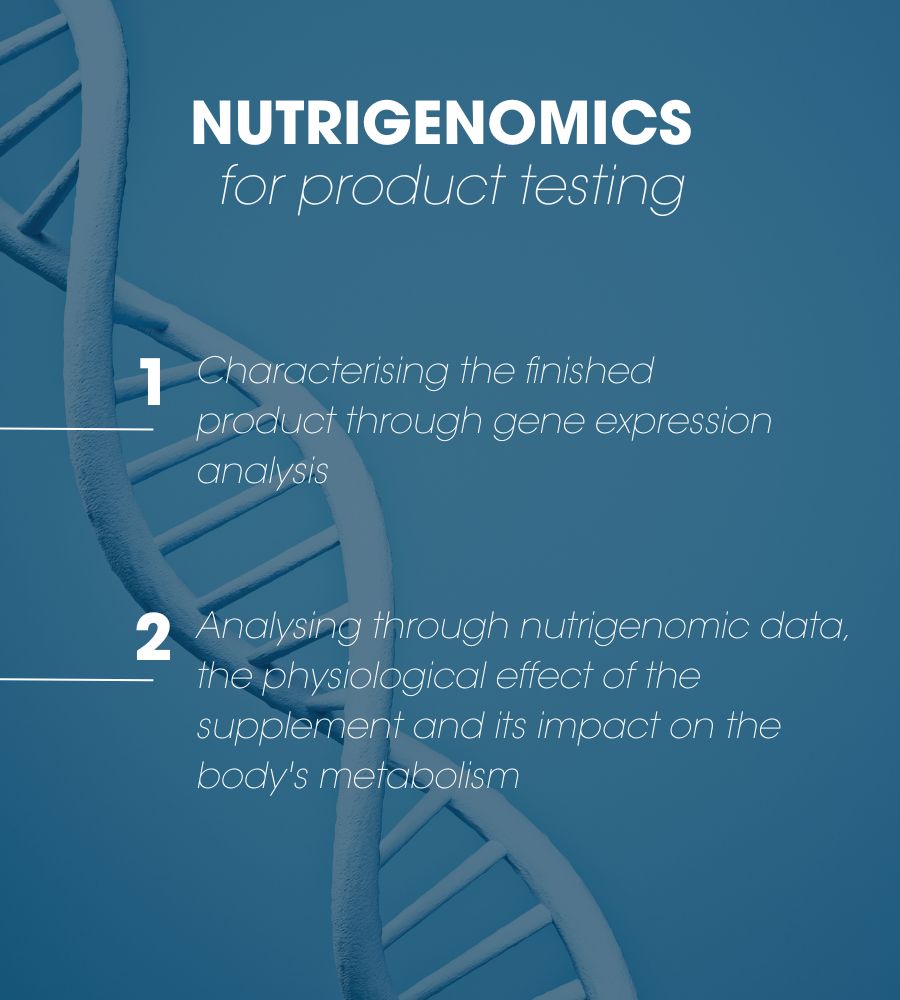
In the first scenario, the nutrigenomic service offers the client the possibility of validating the efficacy of an existing food supplement, through an in vitro pre-clinical study conducted on specific cells involved in the target condition. The ultimate goal is to collect initial nutrigenomic data concerning the efficacy of the supplement. This is followed by a clinical study performed on a group of healthy volunteers, observed before and after taking the formulation, to confirm the result obtained in the first phase and thus validate the efficacy of the nutraceutical product.
The final output of the validation process is a marketing dossier containing the data obtained and the technical-scientific evidence supporting the product.
The second nutrigenomic service offered by Biofarma Group aims to develop, in collaboration with the client, a nutraceutical product oriented to a specific therapeutic target.
The service involves first of all the identification of an active formulation, thanks also to collaboration with key opinion leaders in the reference sector, and the identification of genetic markers on which to act in order to restore a healthy condition.
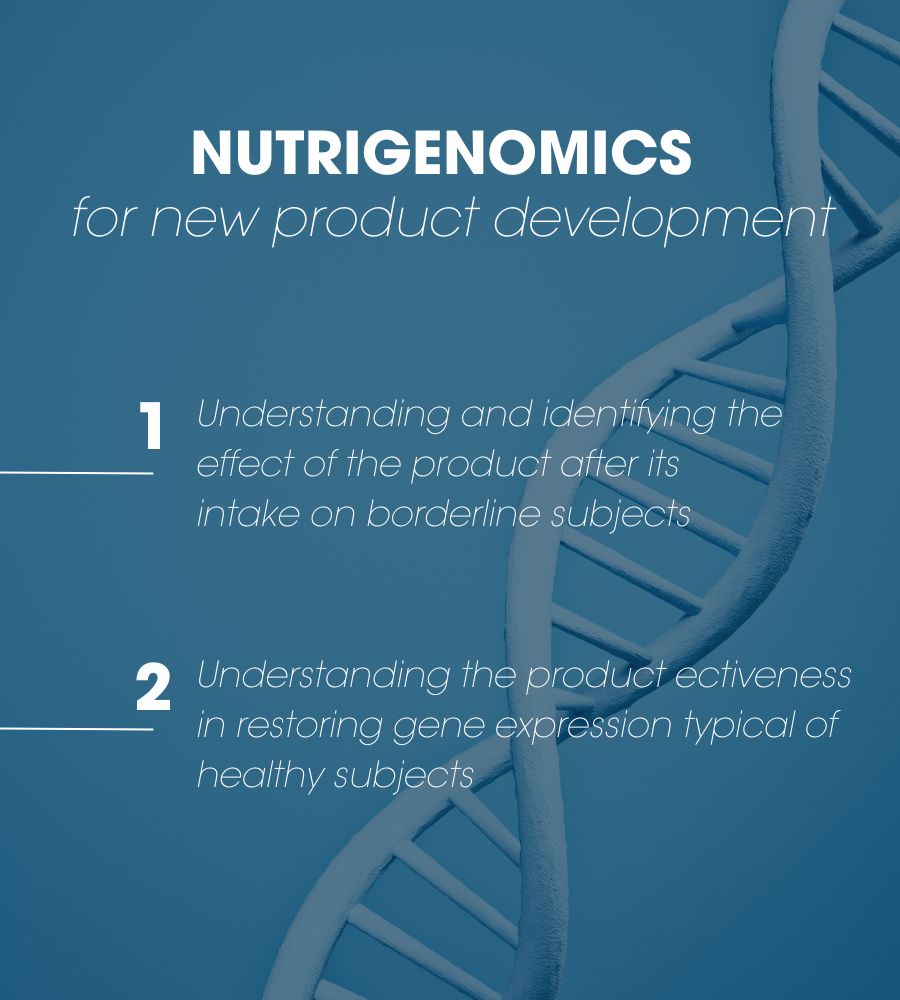
The identified formulation is then tested with a pre-clinical validation phase, a crucial stage in understanding the nutrigenomic implications of the product. It is then possible to proceed with a clinical validation phase conducted on a group of subjects with a borderline health condition and managed in full service by Biofarma Group, thanks to an extensive network of collaborations with key opinion leaders and research centres.
The output of this service is a marketing dossier supporting the product, accompanied by a ‘nutrigenomic card’, which is a document showing, for each borderline individual involved in the clinical study, the genetic profile before and after taking the product studied, thus showing its effects at the genetic level.
This new methodology allows Biofarma Group to offer an exclusive service: after identifying the target of intervention, clients are guided in the selection of the most suitable active ingredients to modulate the genes involved in the identified target, thus guaranteeing a highly scientific and prevention-oriented approach.
It is important to emphasise that the protocol developed for both services is not rigid, but adaptable to the specific needs of the client and the identified therapeutic target, to ensure maximum efficacy.
In conclusion, this approach to nutraceutics marks a milestone in the development of new formulations, representing an innovative method not yet introduced in the market. Indeed, the methodology developed represents a revolution in the supply of supplements, based on the application of nutrigenomics to a specific target. Furthermore, nutrigenomics enables the examination of the real impact of the active ingredients of supplements on the gene expression of tissue-specific cells, giving the possibility to create more effective and targeted formulations, thus improving the efficacy and adaptability of dietary supplements and providing a solid scientific background to support the efficacy of nutraceuticals.
1. Martínez-Rodríguez, R.; & Gil, A. (2012). Nutrient-mediated modulation of incretin gene expression: a systematic review. Nutricion hospitalaria, 27(1), 46–53.
2. Kilberg, M. S.; Pan, Y. X.; Chen, H.; et al. (2005). Nutritional control of gene expression: how mammalian cells respond to amino acid limitation. Annual review of nutrition, 25, 59–85.
3. Costa, C.dosS.; Rohden, F.; Hammes, T. O.; et al. (2011). Resveratrol upregulated SIRT1, FOXO1, and adiponectin and downregulated PPARγ1-3 mRNA expression in human visceral adipocytes. Obesity surgery, 21(3), 356–361.
4. Amirinejad, R.; Shirvani-Farsani, Z.; Naghavi Gargari, B.; et al. (2021). Vitamin D changes expression of DNA repair genes in the patients with multiple sclerosis. Gene, 781, 145488.