
The World Health Organization (WHO) defines active ageing as "the process of optimizing opportunities for health, participation and safety to improve the quality of life of ageing people".
Given its positive effects on individuals, active ageing can be considered a preventive tool to aspire to healthy ageing as much as possible.
Today, more than ever, this is an important issue. Worldwide, the percentage of people over 65 and 80 continuously increases: in 2019, the number of people aged 60 and over was 1 billion. This number will increase to 1.4 billion in 2030 and 2.1 billion in 2050 (1). However, as society ages, older people are not necessarily in the best health, so the ageing of the population is "a triumph and a challenge" for society. While this is inevitable, poor health can also be self-inflicted to some extent.
The so-called baby boomers are aware of this and have begun to adopt a proactive approach to health, focusing on prevention rather than cure. According to a survey conducted on a sample of people in this category, 68% of women and 59% of men said they have a proactive attitude towards health over time. The goal is to stay fit and active for as long as possible and break age-related stereotypes. (2)
The concept of healthy ageing is also shifting from an idea of curing disease and reversing the ageing process to an approach that aims to delay the onset of age-related decline. Therefore, a change of perspective concerns consumers and industry: young people are also increasingly aware of how their current lifestyle choices can affect their long-term health. Consequently, products dedicated to active ageing are no longer the subject of interest only by older consumers. In particular, these are food supplements that, together with a healthy lifestyle, can promote the maintenance of good physical and mental conditions over the years: nutraceuticals aim to prevent or delay the onset of common diseases, to maintain optimal organ function and to counteract their "wear and tear".
The Biofarma group has responded to this market need by developing an innovative product that takes the form of a microencapsulated core with a solid scientific background and cutting-edge technology synonymous with quality and safety.
The nutraceutical formulation aims to promote healthy ageing, with particular attention to the reduction of mitochondrial oxidative damage, one of the main phenomena related to advancing age that leads to a decrease in cell proliferation and, therefore, a progressive degeneration involving organs, tissues, and systems.
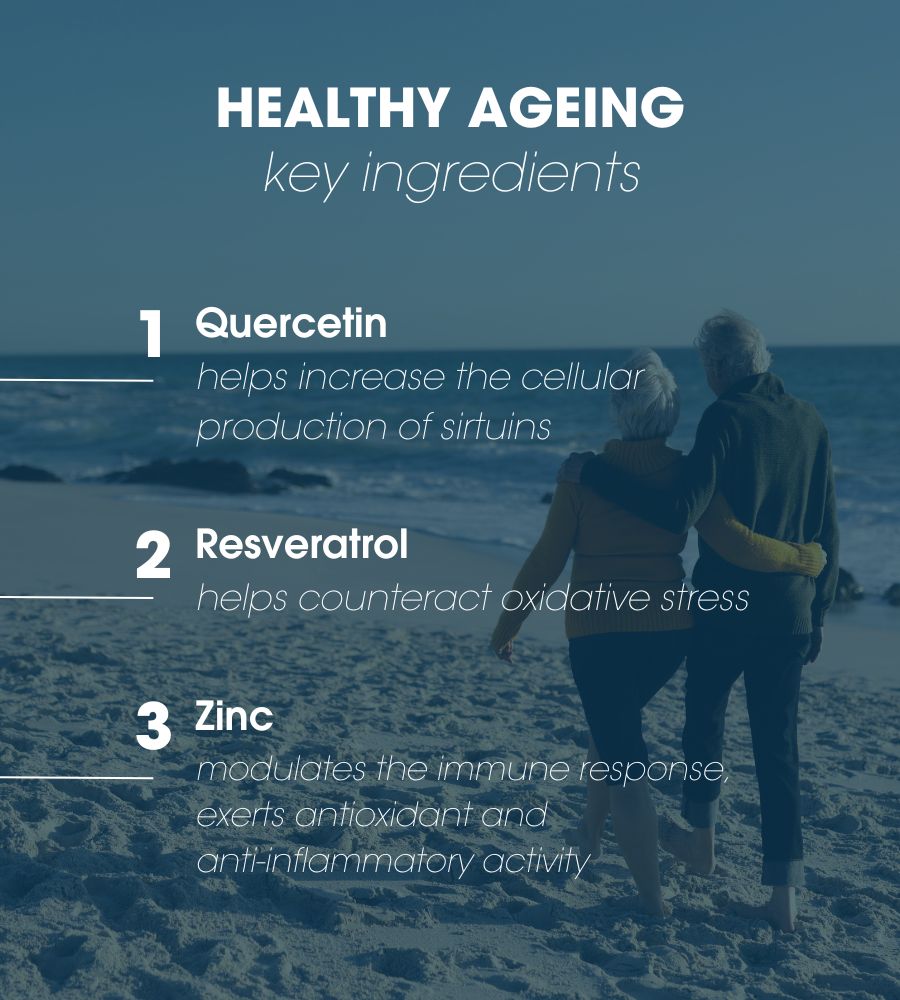
For this reason, three substances with antioxidant properties have been selected on a scientific basis: quercetin, resveratrol, and zinc, with excipients capable of enhancing their synergy.
Quercetin is a flavonoid found in various fruits, vegetables, beverages, and herbal extracts. In nature, it is not present in isolated form but as an aglycone (non-sugar part) of various glycosides, including rutin and quercitrin. In this form, it abounds, in particular, in extracts of horse chestnut, ginkgo biloba, calendula, hawthorn, chamomile, lovage and St. John's wort.
Resveratrol is a naturally occurring phenolic compound found in several foods, such as grapes, peanuts, blueberries, and red wine. Many studies have highlighted its importance in treating ageing through the suppression of oxidative stress, the inhibition of the inflammatory response, the improvement of mitochondrial function and the modulation of apoptosis (3).
Combined with quercetin, its action can increase the cellular production of sirtuins (also called longevity proteins), essential for DNA repair, inflammation control and antioxidant defence, making them an effective ally against senescence.
Finally, zinc is a nutritionally critical trace element essential for the structure and function of numerous macromolecules. In particular, this mineral modulates the immune response and has antioxidant and anti-inflammatory activity.
The innovation of the product also lies in the technology used: microencapsulation. It is a protection technology that encapsulates solid and liquid materials in microparticles. It is widely used in medicine, cosmetics, and food supplements for its advantages to the final product.
In particular, in the nutraceutical field, the potential of microencapsulation is numerous:
provides a protective barrier around sensitive nutrients, vitamins and active ingredients, safeguarding them from degradation caused by external factors and thus ensuring that the nutritional content remains potent throughout the shelf life of the product (4);
can standardize the absorption and bioavailability of certain nutrients subject to degradation or poor absorption in the digestive system;
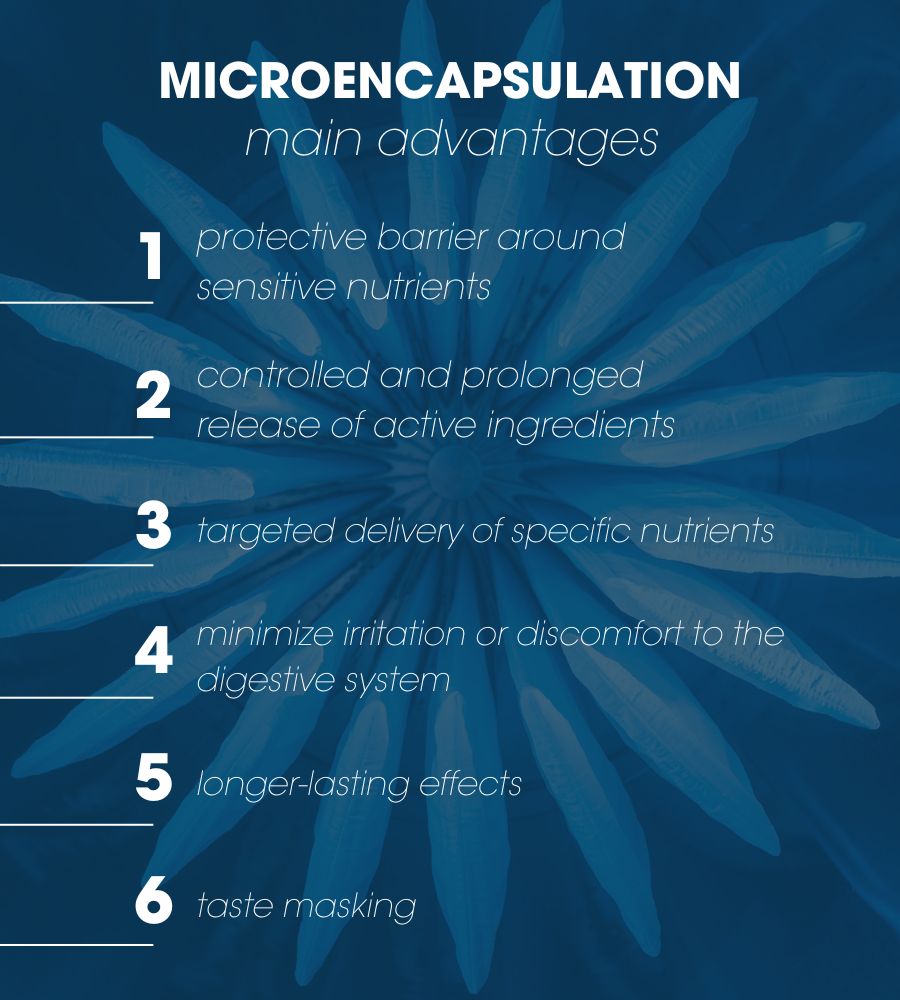
allows a controlled and prolonged release of active ingredients, providing a constant supply to the body and avoiding peaks and drops in nutrient levels (5);
allows the targeted delivery of specific nutrients to certain areas of the body for optimal efficacy (6);
unpleasant tastes or odours associated with certain nutrients can be effectively masked, improving overall palatability and the drinking experience (7);
can prevent interactions between different nutrients within the same supplement, ensuring that they remain stable and effective when combined (8);
allows you to incorporate a variety of ingredients with different characteristics into a single supplement, allowing the creation of complex formulations that offer multiple health benefits;
can minimize irritation or discomfort to the digestive system by controlling the release and interaction of these substances with the body (9);
it can provide longer-lasting effects than traditional forms, as the controlled release ensures a prolonged presence of nutrients in the body (10);
prevents the separation of ingredients in supplements, ensuring even distribution and consistent dosage.
The efficacy of this technology, combined with the ingredients selected for the formulation, was tested through a preclinical in vitro study conducted on human mesenchymal stem cells (hAT-MASCs) obtained from adipose tissue from healthy donors. It is a model of cellular senescence that is both intrinsic and extrinsic and, therefore, caused by both genetic and external environmental factors.
The results demonstrated an essential efficacy of the microencapsulated product, highlighting in particular:
a reduction in cellular senescence;
the restoration of the homeostatic condition of cell proliferation;
a reduction in DNA damage;
a reduction in cellular inflammation (proinflammatory cytokines).
These results open up a wide spectrum of applications for developing products aimed at different objectives, whose common denominator is the presence of the microencapsulated core. It is, in fact, possible to create a complete line of formulations comprehensively addressing the preparation and treatment of healthy and active ageing. The main areas you can focus on are the beauty and health of the skin, cardio-metabolic well-being, cognitive support, the maintenance of osteoarticular health and the enhancement of muscle mass.
The multifactorial approach makes it possible to holistically address ageing challenges, offering customized solutions for different areas of interest. This diverse range of products can help to improve quality of life and maintain overall well-being, allowing people to approach the ageing process with greater vitality and health.
Pietrasik, T. (sd). Ageing. Retrieved from World Health Organization: https://www.who.int/health-topics/ageing#tab=tab_1
Healthy Ageing: Targeting the Baby Boomer Market, FMCG Gurus
Zhou DD, L. M. (2021). Effects and Mechanisms of Resveratrol on Aging and Age-Related Diseases. Oxid Med Cell Longev., 2021:9932218.
Lin SF, C. Y. (2016). Improving the Stability of Astaxanthin by Microencapsulation in Calcium Alginate Beads. PLoS One. , 11(4).
Budinčić JM, P. L. (2021). Study of vitamin E microencapsulation and controlled release from chitosan/sodium lauryl ether sulfate microcapsules. Carbohydr Polym., 251:116988.
Li P, Y. Z. (2015). Microencapsulation of coupled folate and chitosan nanoparticles for targeted delivery of combination drugs to the colon. J Microencapsul., 32(1):40-5.
Al-Kasmi B, A. M.-Z. (2017). Mechanical microencapsulation: The best technique in taste masking for the manufacturing scale - Effect of polymer encapsulation on drug targeting. J Control Release., 134-141.
Maurya VK, B. K. (2020). Vitamin D microencapsulation and fortification: Trends and technologies. J Steroid Biochem Mol Biol., 196:105489.
Manjanna KM, S. B. (2010). Microencapsulation: an acclaimed novel drug-delivery system for NSAIDs in arthritis. Crit Rev Ther Drug Carrier Syst., 509-45.
Basta G, M. P. (2021). Microencapsulation of cells and molecular therapy of type 1 diabetes mellitus: The actual state and future perspectives between promise and progress. J Diabetes Investig., 301-309.